Your guide to data collection, integration, and reporting.
HB 98 presents a significant opportunity to strengthen Ohio’s work-based learning ecosystem. As colleges expand employer engagement, student tracking, and reporting processes, many institutions are evaluating how to align staffing, funding, and technology resources to support sustainable implementation. Based on Grouptrail’s experience supporting workforce education, career pathways, and work-based learning initiatives, we’ve identified several implementation strategies that can help institutions meet HB 98 objectives. Many institutions can leverage existing systems while introducing targeted and integrated tools that address work-based learning tracking, employer engagement, documentation, and reporting requirements.
Why Ohio is positioned for success
- Strong employer demand for skilled talent
- Existing workforce development investments
- Community colleges already serving as regional workforce hubs
- Increased focus on career-connected learning
- Opportunity to create statewide visibility into student outcomes
Key areas for institutional readiness
- Employer engagement capacity
- Student participation tracking
- Data collection and reporting
- Cross-system integration
- Outcome measurement
HB 98 represents more than a reporting requirement. It creates an opportunity to strengthen connections between education and employment, expand access to meaningful work-based learning experiences, and provide greater visibility into student outcomes. Institutions that establish scalable processes, effective partnerships, and sustainable data practices today will be best positioned to maximize the long-term impact of Ohio’s workforce development investments.
Implementation roadmap
Most institutions have pieces of information about students’ work‑based learning experiences, but those pieces rarely add up to a full picture. The opportunity now is to move from scattered, inconsistent data toward a unified understanding of the full range of work‑based learning happening across the university. To do that, institutions first need clarity: What exactly counts as WBL? How is it defined across disciplines? And where does that information currently live?
Today, WBL data typically sits in two places:
- The ERP, where some courses may be tagged for internships, practicums, or co‑ops—though tagging varies by department and system flexibility.
- Career services, where staff track placements and outcomes in spreadsheets or purpose‑built tools that don’t always integrate cleanly with other systems.
Even well‑resourced institutions encounter familiar structural constraints: limited budgets for new infrastructure, legacy systems that weren’t designed for modern reporting needs, procurement processes that add time to any technology change, and the ongoing challenge of encouraging consistent student self‑reporting. Integrating systems into a single authoritative record updated daily, and making WBL visible in fields like the humanities where pathways are less linear requires thoughtful coordination rather than simple technical fixes.
Building a complete and accurate picture of WBL means connecting existing systems and creating lightweight mechanisms for capturing information from multiple stakeholders:
- Students, through low‑friction reporting
- Faculty, who often embed WBL into coursework in ways not captured by current systems
- Employers, who can validate experiences and outcomes
- Publicly available sources that can fill in gaps
The core challenge isn’t just data collection—it’s the time and technology burden placed on students, faculty, and employers. Manual processes discourage participation, and in some cases students may avoid reporting experiences if they believe it could trigger transcripted credit or fees. This is why the technology approach matters.
The right infrastructure reduces the time burden, integrates existing systems, and gives stakeholders simple, intuitive ways to contribute information. With the right foundation, institutions can shift from reactive compliance to proactive strategy.
Definitions and map
Shared definitions and scope
A successful WBL strategy begins with shared state-wide definitions. Leadership must align on what counts as work‑based learning, what falls outside the scope, and how to classify experiences that don’t fit neatly into traditional categories. This is especially important for humanities and social‑science disciplines, where career pathways are less linear and WBL may take the form of research, creative work, community engagement, or project‑based learning rather than formal internships. Establishing a clear, state-wide taxonomy ensures that every unit—from academic departments to career services to institutional research—is speaking the same language and contributing to a coherent, unified dataset.
Current-state systems map
Most institutions already have pieces of WBL data scattered across multiple systems, but few have a complete understanding of where everything lives. A systems map provides leadership with a clear view of the current landscape: what data exists, who owns it, how accessible it is, and where the bottlenecks are. This includes ERPs with limited flexibility, spreadsheets maintained by individual staff, purpose‑built tools that don’t integrate, and shadow systems created to work around procurement delays. Mapping the current state helps leadership see the fragmentation problem in one place and identify the highest‑leverage opportunities for integration.
Standards and strategy
Data standards and authoritative record model
To move from fragmented data to actionable insight, institutions need a clear definition of what constitutes the authoritative record for WBL. This includes establishing required fields, defining data quality expectations, determining refresh frequency, and creating rules for resolving conflicting information across systems. A well‑designed authoritative record model ensures that dashboards, compliance reports, and strategic analyses are all drawing from the same trusted source. For leadership, this is the foundation that enables confident decision‑making and reduces the operational burden on staff who currently spend hours reconciling mismatched datasets.
Low friction student self-report strategy
Self‑reported data is essential for capturing the full range of WBL experiences, especially those that occur outside formal placements. But students rarely complete long or complex reporting forms, and many fear unintended consequences such as transcript fees. A low‑friction strategy focuses on mobile‑first workflows, minimal data entry, automated reminders, and clear messaging about how the information will—and will not—be used. Integrating data capture directly into Canvas through an LTI makes reporting even easier by placing the workflow inside a platform students already use every day. Leadership needs a plan that acknowledges the realities of student behavior and builds reporting mechanisms that are simple, trustworthy, and integrated into the rhythms of the academic year.
Engagement and validation
Faculty engagement framework
Faculty are often the most overlooked source of WBL data, especially in disciplines where experiential learning is embedded in coursework. A faculty engagement framework outlines how to identify course‑based WBL, how to standardize reporting without adding administrative burden, and how to surface the rich but often invisible WBL happening in humanities and social‑science programs. Leadership needs a strategy that respects faculty autonomy while creating consistent pathways for capturing the learning experiences they already facilitate.
Employer data and validation model
Employers play a critical role in validating student experiences, but they often lack the time or capacity to navigate complex reporting systems. A streamlined employer data model defines what information is needed, how often it should be collected, and how to minimize friction for employer partners. This includes simple validation workflows, clear expectations, and communication templates that reduce back‑and‑forth. For leadership, this model strengthens employer relationships while ensuring the institution can meet reporting requirements and track meaningful outcomes.
Integration and reporting
Integration and automation reporting roadmap
A sustainable HB 98 data strategy depends on knowing what can be automated today and what still requires manual bridging. Most colleges are working with aging systems, limited budgets, and slow procurement cycles, so the roadmap focuses on practical steps: automating high‑confidence data flows where possible, using lightweight middleware or APIs when available, and relying on structured manual processes only where systems cannot yet talk to each other. The goal is to help institutions reduce staff workload, improve data quality, and accelerate reporting by making smart, incremental technology choices that strengthen interoperability over time.
Reporting and compliance
Compliance requirements like HB 98, Perkins V, and state workforce mandates can do more than trigger reporting—they can anchor a smarter, more unified approach to WBL data. Colleges benefit when they understand not only what is mandatory and what is flexible, but also how to use these requirements to build a reporting rhythm leadership can rely on. Daily and weekly views help teams monitor employer validations, placements, hours, and documentation status; annual views support state reporting, program review, and long‑term planning. Visualizing WBL differently for humanities and STEM—highlighting project‑based, research, or creative work alongside traditional technical competencies—ensures all disciplines are represented accurately. Layering equity, access, and outcomes data across these views allows institutions to identify who is participating, who is benefiting, and where gaps persist. When compliance reporting is aligned with these broader institutional priorities, colleges gain a clearer, more actionable picture of their workforce programs and can use the same data to strengthen student experience, employer engagement, and institutional effectiveness.
Governance and alignment
Governance and roles
Strong governance is what keeps HB 98 data work from drifting or stalling as priorities shift. Institutions need a clear model that spells out who owns the authoritative record, who maintains data quality, who approves definitions, and who is accountable for compliance versus strategic reporting. When these roles aren’t explicit, WBL efforts often slow down due to unclear ownership or competing interpretations of the data. A well‑designed governance structure distributes responsibility across teams while ensuring accountability, consistency, and long‑term sustainability—so the work doesn’t depend on any single person or department.
Aligning with Workforce Pell
Colleges can dramatically reduce duplication and improve data quality by aligning the core elements required across work‑based learning, apprenticeships, state workforce reporting, and Workforce Pell. All four areas rely on the same foundational data—employer partners, competencies, hours, credentials, and employment outcomes—yet they are often tracked in separate systems with different definitions. By standardizing these shared fields and building coordinated workflows, institutions can capture data once and reuse it across multiple reporting requirements. This alignment ensures that employer validation, hours and competency tracking, credential attainment, and outcomes reporting follow a consistent structure, whether the student is in a WBL placement, a registered apprenticeship, or a Workforce Pell–eligible program. A unified approach not only strengthens compliance and audit readiness but also gives colleges a clearer, more comprehensive view of how their workforce programs perform across credit and noncredit pathways.
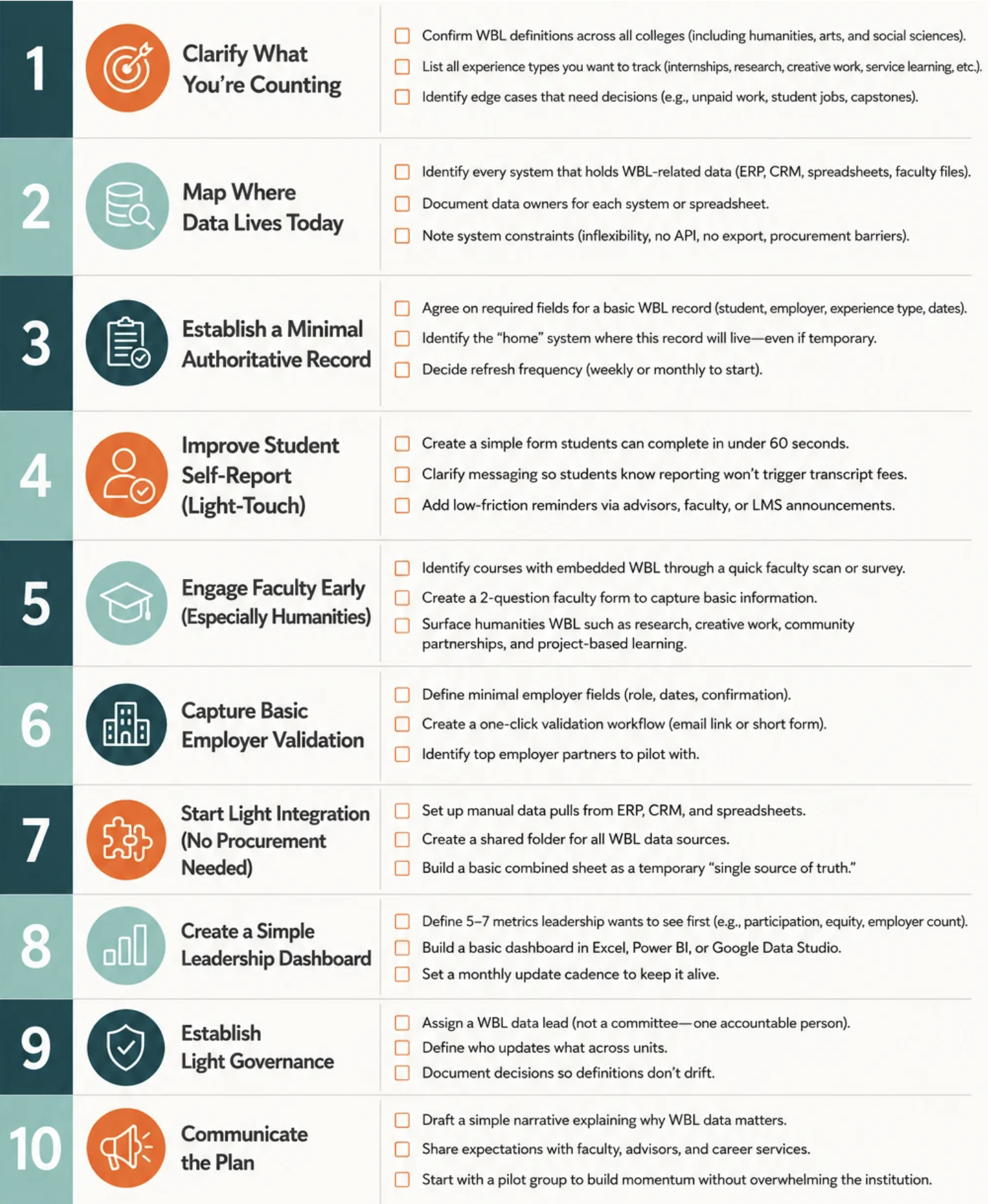
Readiness checklist
How Grouptrail supports this toolkit
Grouptrail can serve as the customizable operational system of record hub for:
- Documentation and audit trails
- Workflows for data validation by students, faculty and partners
- Credit and Noncredit program data
- Reporting dashboards
- Canvas and ERP integration
Sinclair Community College case study
Sinclair Community College partnered with Grouptrail to build a unified infrastructure for tracking work-based learning and employer engagement across one of the largest community colleges in the country. Serving 20,000+ students, Sinclair needed a system that could consolidate data from Ellucian Colleague, departmental spreadsheets, and employer workflows into a single operational hub.
Grouptrail delivered a configurable platform that supports internships and apprenticeships enabling faculty, advisors, and workforce teams to collaborate in real time. The system provides dashboards for program-level reporting and grant compliance. Sinclair’s implementation demonstrates how a large, decentralized institution can centralize work-based learning data at scale while maintaining flexibility for diverse academic and workforce programs.
Grouptrail is the infrastructure layer partner for colleges to power WBL data collection, integration, and reporting
Grouptrail imports from and integrates with existing systems like Canvas, Ellucian Colleague and Banner, allowing colleges to sync data across CRMs, SIS and ERP platforms, state labor data, and other related workforce systems. Reduce administrative burden and create a smoother experience for both staff and learners. That means:
- No more entering the same data in multiple places
- Seamless data flow across departments
- A single source of truth for Work-based learning records
Eliminate duplicate data entry. Connect your systems. Simplify work-based learning tracking. All in Grouptrail. Proven and tested since 2004.
Learn more in a demo meeting >